
Affiliate disclosure
Independent editorial coverage on AI Growth Verdict contains affiliate links marked as sponsored. AI Growth Verdict may earn a commission if you buy through those links, at no extra cost to you. All views, scores, and verdicts remain independent. Traffic Xray is sold through JVZoo. Large numbers, income examples, campaign counts, and “verified traffic” figures on the vendor page are marketing claims, not independent tests.
Fast Verdict: Traffic Xray Scores 7.3/10
Traffic Xray earns a 7.3/10 honest score as an AI traffic agent and competitor traffic analysis tool. Verdict-first: it delivers broad traffic source intelligence, campaign recipe ideas, and a connected workflow from scan to publish. Deductions come from inconsistent sales-page claims on campaign counts, unknown data quotas, cloning compliance risks, and no proof of traffic or sales outcomes. No fluff. Clear verdicts for buyer fit.
Best For
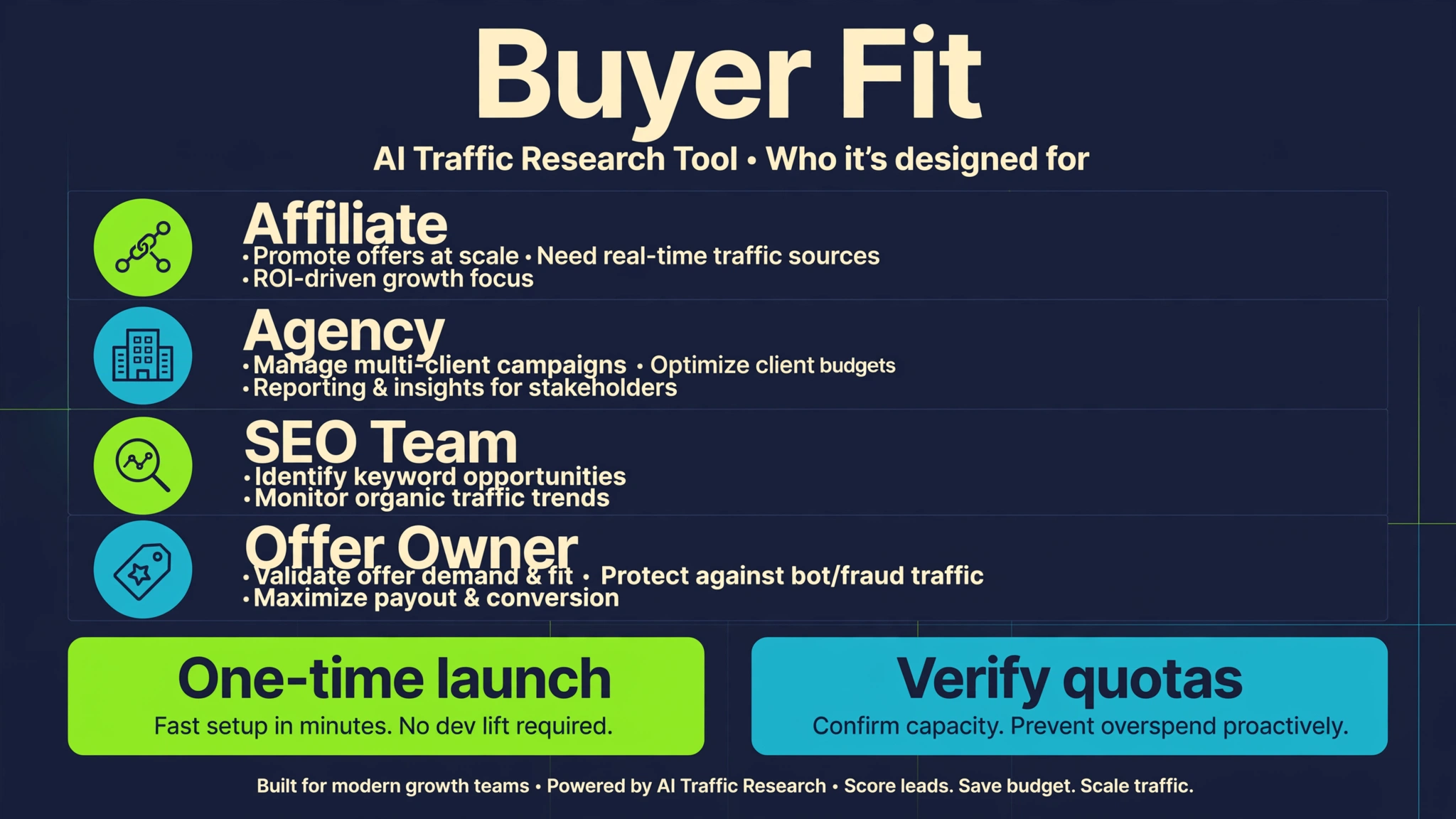
Affiliate marketers, traffic builders, agencies doing client research, niche researchers, and offer owners who want a connected scan-to-remix-to-publish workflow. Users must still handle original positioning, tracking, and compliance checks.
Not For
Buyers seeking guaranteed traffic or ROI. People aiming to copy competitor ads verbatim. Teams needing audited enterprise quotas and SLAs. Anyone expecting a specialist SEO suite to replace Ahrefs or SEMrush depth.
Pros
- Six traffic sources in one scan: organic, paid, referral, backlinks, direct, social.
- Campaign recipes with hooks, formats, and assets for remixing.
- One-click AI creation and publishing workflow.
- Sales-page claims a one-time launch price under $300.
- Niche Atlas and ad library decoder for quick intelligence.
Cons
- Inconsistent vendor claims on campaign and template counts.
- Unknown quotas, data freshness, and third-party charges.
- Cloning risks intellectual property issues without review.
- Dynamic launch pricing with countdown, not permanent.
- No independent verification of traffic or sales results.
What is Traffic Xray?
Traffic Xray is an AI traffic spy tool positioned on its sales page as the world's first AI traffic agent. This competitor traffic analysis tool asks you to paste a competitor, website, niche, or influencer URL, then scan traffic sources, inspect campaign evidence, and remix campaign recipes into new assets. Vendor positioning is “Locate. Clone. Beat.” Treat “beat” as slogan copy, not a promise that you will outperform anyone.
The product is aimed at affiliate marketers, traffic builders, agencies, niche researchers, and owners promoting their own offers. It sits between a traffic source analyzer, an ad spy and campaign research tool, and AI campaign creation and publishing software. That connected loop is the actual pitch. You are not buying a single-channel rank tracker. You are buying a research-to-production workflow that still needs a real offer, a real audience, and human review.
The official Traffic Xray sales page claims coverage across Google, YouTube, Facebook, Instagram, LinkedIn, X, TikTok, and Pinterest, plus ad-library decoding. It also repeats “6 Sources. 11 Platforms. 18 Campaign Types.” The captured page never publishes one clean, deduplicated list of all 11 platforms. That gap matters. Name the platforms you care about and confirm them inside the live product before you treat the slogan as coverage.
This Traffic Xray review 2026 treats the software as campaign cloning software with traffic source intelligence, not as a magic traffic source. Cloning here should mean remixing a public angle: hook, format, channel mix, and proof trail. It should not mean copying protected creative, trademarks, scripts, or private strategy. If you need a specialist SEO database, Ahrefs or SEMrush still do deeper work in their lanes. If you need a connected scan-to-publish loop, Traffic Xray is the category the vendor is selling.
How does Traffic Xray work?
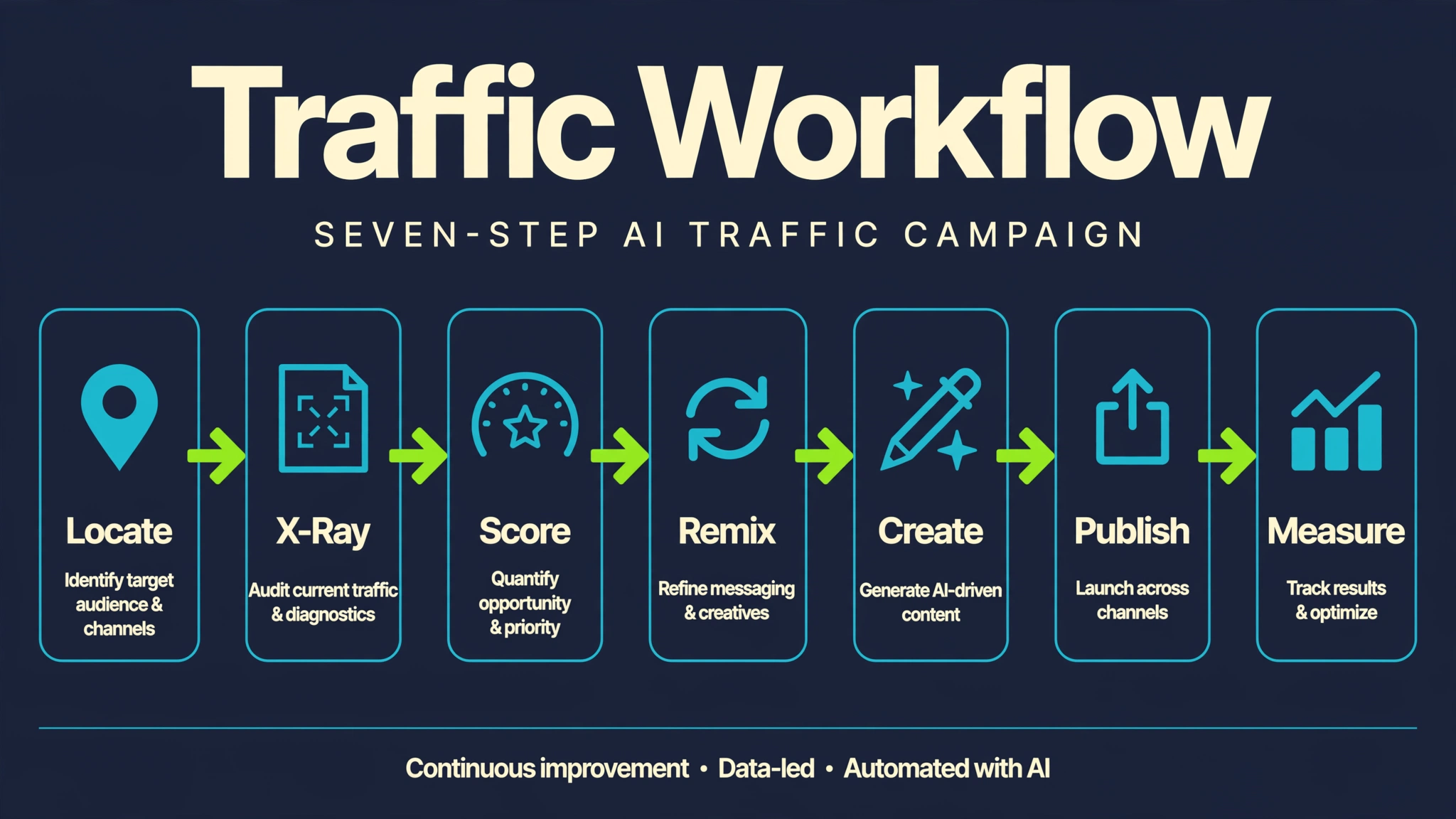
Traffic Xray works as a stated loop: paste a competitor, website, niche, or influencer URL, scan six traffic sources, inspect campaign evidence, clone a campaign recipe, create image, video, article, or ad creative, then publish or schedule to connected social accounts. The sales page says AI traffic agents can read analytics and recommend or run the next campaigns. That is the vendor workflow. Your job is to keep the human steps the page underplays: offer quality, original positioning, tracking, disclosures, and platform policy.
The traffic source analyzer is strongest when you treat each scan as evidence, not as a finished campaign. A long-running ad, a Reddit thread, or a keyword cluster tells you where attention already exists. It does not tell you that the same creative will convert on your landing page, with your offer, in your geography, under today's ad policies. Score the evidence. Then rewrite the angle.
Practical workflow buyers should follow. Choose a legitimate offer and a market you can serve. Collect a short list of competitor, niche, and influencer URLs that already attract the same buyer. Run Site X-Ray and compare Organic, Paid, Referral, Backlinks, Direct, and Social side by side. Open source links. Look at the original posts, keywords, ad placements, and threads behind the scores. Shortlist campaigns with a mix of hard data and fit for your offer. Adapt the hook, audience, proof, and format instead of copying the asset. Create original image, video, article, or ad creative. Add UTM tracking, required disclosures, and a clear next step. Publish or schedule. Read the analytics. Feed what actually happened into the next campaign, whether the agent recommends it or you choose it yourself.
That sequence is affiliate marketing traffic research plus competitor ad research software, with a production layer attached. It can cut the hours spent hunting swipe files across six tabs. It cannot replace a conversion-tested offer, a compliant landing page, or a distribution plan. If the agent publishes while you sleep, you still own what went live.
See whether Traffic Xray fits your research workflow
What does Traffic Xray include?
Traffic Xray includes scans of six sources: Organic, Paid, Referral, Backlinks, Direct, and Social. The sales page slogan is "6 Sources. 11 Platforms. 18 Campaign Types." Named platforms include Google, YouTube, Facebook, Instagram, LinkedIn, X, TikTok, and Pinterest, plus ad-library coverage. The captured page does not publish one clean, deduplicated list of all 11 platforms. Confirm the Traffic Xray ad library coverage you need inside the live product.
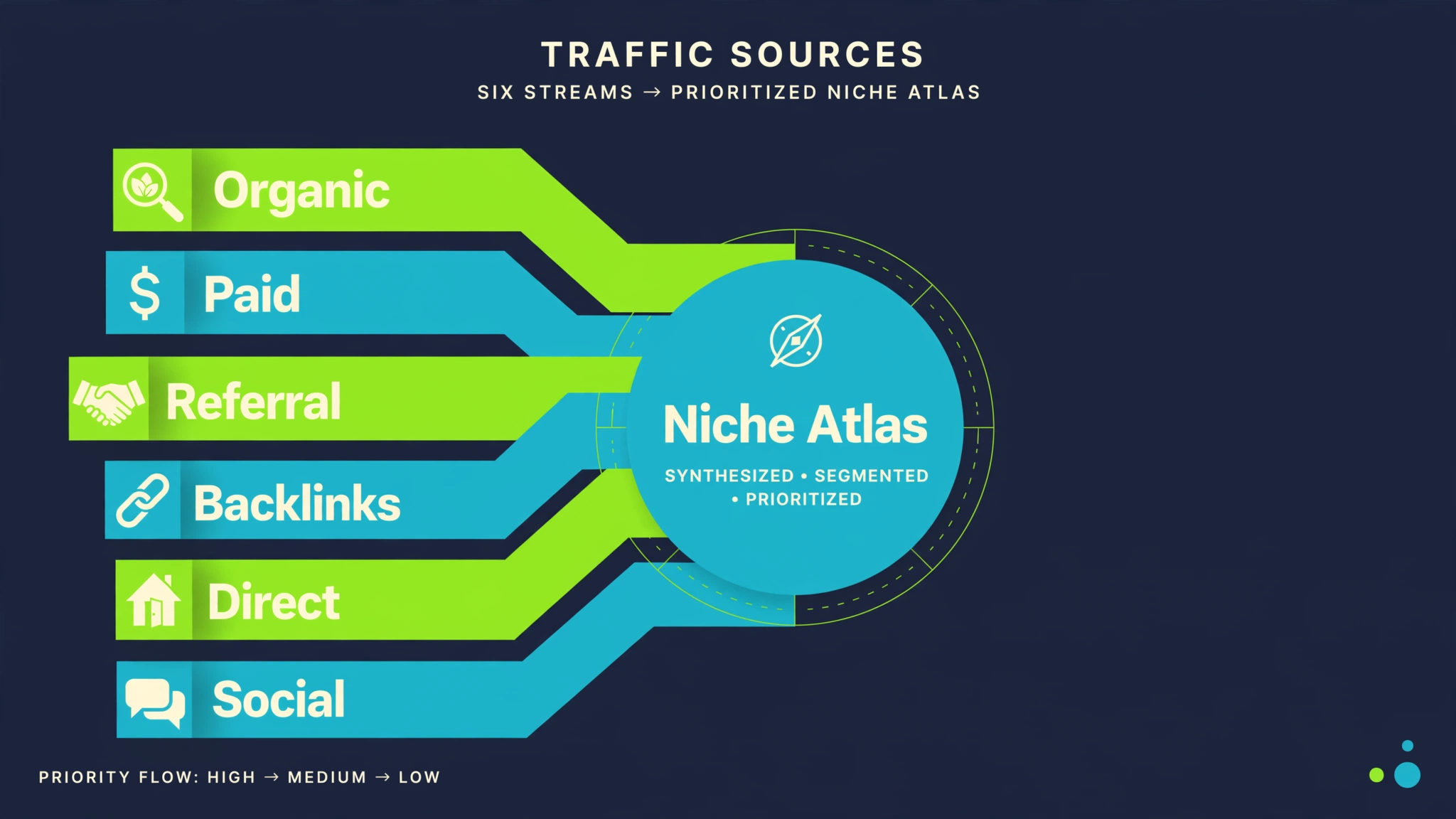
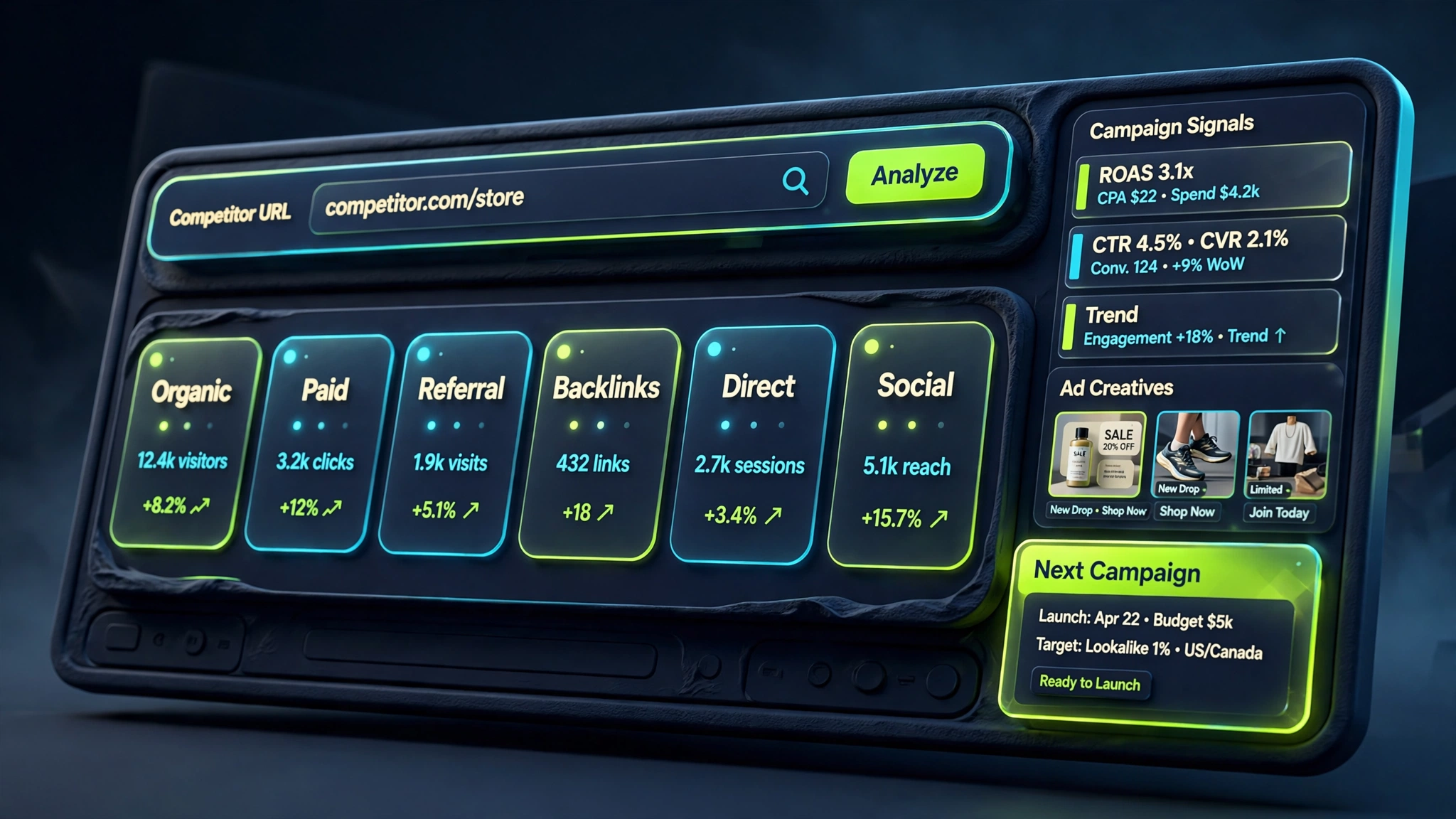
Niche Atlas View is sold as a market map: players, traffic mix, and weaker channels on one screen. Site X-Ray is the six-source scan that surfaces campaigns, ads, posts, keywords, links, platform splits, source links, and claimed performance signals. The Ad Library Decoder is positioned as parallel decoding of named social and ad platforms. Treat those as vendor feature names until you run a scan on a market you already know.
Campaign template counts are inconsistent vendor claims. One block says 20 to 60 templates per scanned site. Another says a 57-campaign template library. Proof blocks say 10 to 100 campaigns from one scan. Preloaded DFY niches claim 3,000 ready-to-clone campaigns, also described as hundreds or more per niche. Those numbers should be verified in the live product on a site you control. Do not plan a content calendar around a count the page cannot keep consistent.
Campaign recipes, as described, include hooks, formats, shot descriptions, script beats, opening lines, and build steps. Source links are supposed to lead to original posts, keywords, ad placements, or Reddit threads. The page uses an example of an ad running 300 days. That is a sales-page example, not proof that your cloned version will last or convert. Social traffic is broken out by platform rather than one aggregate percentage, which is useful if the split is accurate. Two template scores out of 100 are said to name whether each score comes from hard data, AI judgment, or a hybrid. That honesty about method is a plus, if the labels are visible on every card.
Other claimed functions: global priority weighting, filters, favorites, a swipe-file library, one-click creation of image, video, article, or ad creative, AI publishing or scheduling to connected accounts, analytics feeding later recommendations, scheduled context-aware AI traffic agents, and an Infinite Campaigns Showcase feed. The page claims full commercial rights for client and agency use. Read the exact license language before you bill a client. These items are presented as parts of the bundle, not as separately labeled bonuses.
Traffic Xray Core is given a claimed standalone value of $4,997. "Our Most Profitable Traffic Niches" is given a claimed standalone value of $2,000 or more, with pre-researched niches, ready-made campaign libraries, long-running ad examples, and monthly refreshes. Claimed total standalone value is $6,997 or more. The page also claims enterprise data pipes worth $10k or more and names DataForSEO, SerpAPI, ScrapeCreators, ScrapingBee, SpyFu, and Serpstat in its platform disclaimer. The same page does not clearly document buyer account limits, scan quotas, data freshness, or whether third-party usage charges can apply. Ask those questions before you treat the stack as unlimited.
How much does Traffic Xray cost?
Traffic Xray pricing on the captured sales page shows a $267 launch one-time payment, with $417 shown as a crossed-out reference. The page repeats instant access, one-time payment, and no monthly fees ever. A dynamic countdown says the price will increase at midnight or revert later. Treat that countdown as time-sensitive marketing. It is not evidence of a permanent price. The captured page shows no tier selector, no recurring plan, and no payment plan. JVZoo is shown as the retailer. The official page disclaims affiliation with Facebook, Google, JVZoo, WarriorPlus, ClickBank, TikTok, LinkedIn, and third-party data providers.
| Reported sales-page offer | What it appears to include | Verify before buying |
|---|---|---|
| $267 one-time | Core tool, niches, commercial rights, 30-day guarantee | Live page for countdown, quotas |
| Crossed-out $417 | Reference price | Dynamic; may change |
| Claimed values $6,997+ | Core $4,997, niches $2,000+ | Marketing claims |
| 30-day risk-free | Run scan; email if unsatisfied | No questions asked? Procedure unclear |
| JVZoo retailer | Handles payments | Unknown scan quotas |
The 30-day risk-free guarantee, as displayed, says to run a first scan and, if you do not finish knowing more about the market's traffic than before, email within 30 days for a full refund. The page says no questions asked and no hoops. It does not publish a detailed refund procedure, required proof, or processing time. Vendor technical figures such as 57 campaigns, source links, a 51-minute run time, and a stated $6.232 per-scan cost are described as measured from live product runs and as varying by competitor, niche, and market. The visible page does not explain the $6.232 calculation. Treat all of those as claims that need buyer verification, including unknown scan and data quotas.
Verify the current launch terms
Is Traffic Xray worth it?
Traffic Xray is worth considering if you will use it as research and campaign ideation, not as a machine that prints visitors. The connected loop (scan six sources, inspect proof, remix a recipe, create assets, publish, read analytics) can shorten the time between "who is getting traffic" and "I have an original draft to test." It does not remove the work that actually converts: a real offer, audience understanding, compliant creative, tracking, landing page quality, and a distribution plan.
The sales page shows income and traffic examples. The same page says those examples are atypical and individual results vary. That disclaimer is the honest part. Do not buy because a headline mentions millions in traffic or a 300-day ad. Buy if the research workflow matches how you already ship campaigns, and if the reported one-time launch price still beats the monthly stack you would otherwise pay for spy tools plus a writer plus a scheduler.
The 7.3/10 honest score sits here on purpose. Breadth and workflow are real buyer appeal. Claim inconsistency, unknown quotas, and copy/compliance risk keep it out of the 8s. If you need audited enterprise SLAs, stay with specialist suites. If you need a cheaper swipe-file habit with a publish button, this is in range, after you verify live terms.
Who should use Traffic Xray?
Affiliate marketers
Affiliate marketers get the most obvious buyer fit. You already hunt winning angles across paid social, YouTube, and search. Traffic Xray compresses that hunt into a six-source scan plus campaign recipes. Use it to see where a competing affiliate or vendor is already buying attention, then rewrite the hook for your link and your landing page. Do not paste their ad copy into your account. Networks, FTC rules, and platform policies still apply. Your edge is speed of research plus original positioning, not identical creative.
Agencies and client research
Agencies can use Site X-Ray and Niche Atlas as a first-pass competitor brief: traffic mix, weaker channels, long-running ads, and source links to show a client. The page claims full commercial rights. Verify the license before you resell a traffic strategy. Also verify scan quotas if several account managers will run the product daily. A one-time launch price is attractive next to monthly spy-tool seats, but unknown data limits can erase that math. Keep human QA on every asset that leaves the agency.
Niche discovery
Niche researchers can paste category sites, influencer URLs, or market leaders and look for referral threads, backlink patterns, and social splits that a keyword tool will miss. Preloaded DFY niches are a starting library, not proof that those niches remain profitable for you. Refresh the scan, check the source links, and confirm demand against your own offer economics before you commit inventory or ad spend.
Paid-ad researchers
Paid-ad researchers should treat the Ad Library Decoder and ad-duration claims as a faster way to shortlist ads that have survived. A 300-day example on the sales page is a teaching story, not a forecast. Open the source ad. Note the offer, the landing page, the audience, and the claims. Then write a new ad that you can defend. Combine Traffic Xray with native Google and Meta ad libraries when you need the original placement, not only a recipe card.
Organic SEO and content teams
Organic SEO and content teams can use Organic, Backlinks, and Referral lanes to see which formats and topics already pull visits, then brief writers with a remix rather than a duplicate. This is not a replacement for Ahrefs or SEMrush crawl depth, rank tracking, or technical audits. It is a traffic source intelligence layer that can feed the content calendar. Keep a specialist SEO suite if rankings and indexation are the job.
Owners with their own offers
Offer owners should scan their own site against two or three leaders, then steal the channel mix, not the brand. If competitors live on Pinterest and you only post to Facebook, that split is the finding. If they run a long-form comparison article that ranks, write a better original. Direct and referral data can also show partnerships you have ignored. The product still will not fix a weak offer or a slow checkout.
 Review the live Traffic Xray package
Traffic Xray vs copying competitors
Competitor research is not a license to copy. Traffic Xray can show you public ads, posts, keywords, and traffic mixes. It does not grant rights to protected creative, trademarks, private data, scripts, or confidential strategies. A cloned campaign idea still needs original positioning, legal review, brand fit, and platform-policy checks. If you ship a near-duplicate ad into a paid account, you take the policy, copyright, and brand risk, not the software vendor.
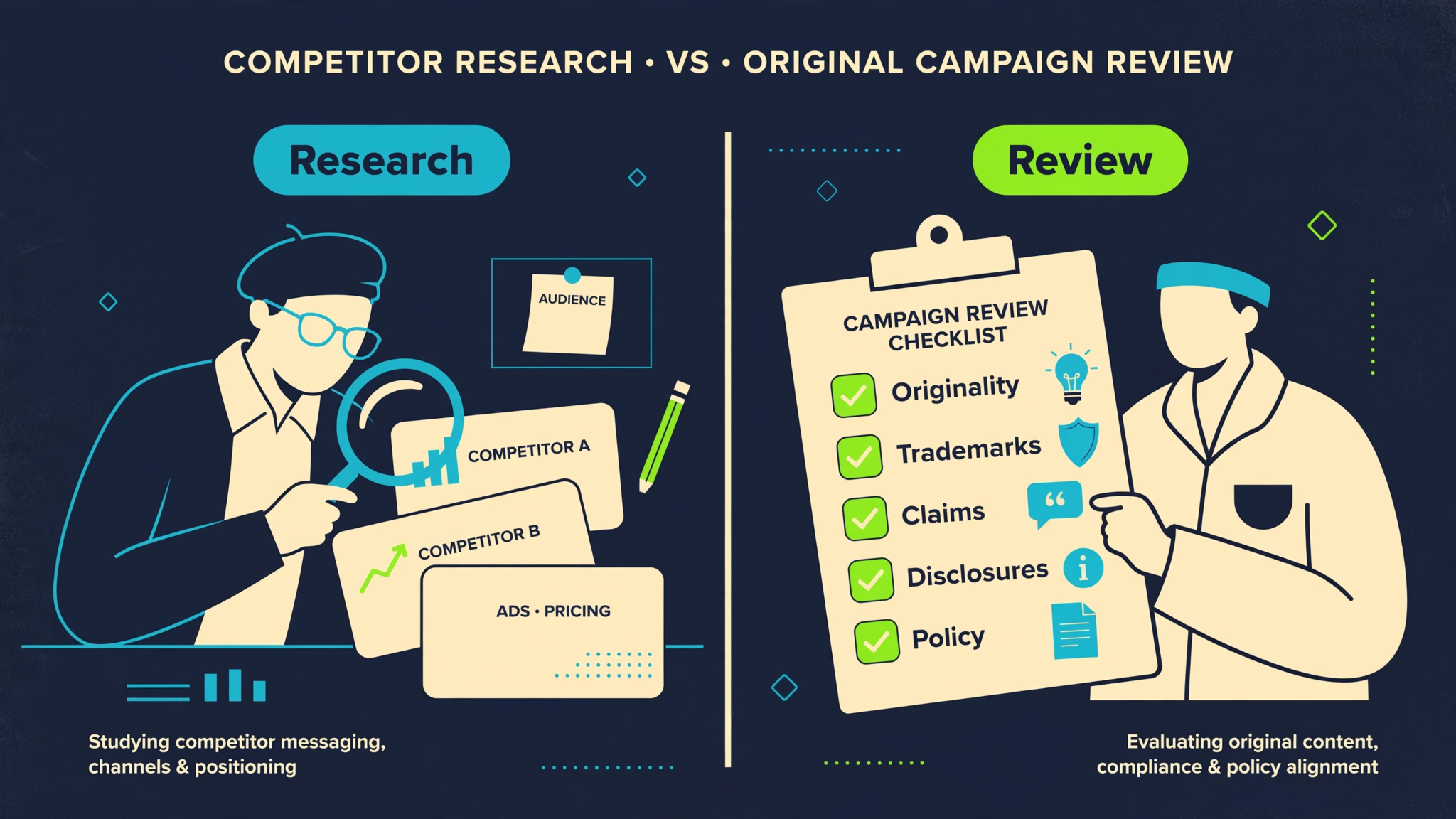
Review every AI-generated asset for quality, accuracy, originality, and suitability before it goes live. Model behavior, pricing, platform availability, and data-provider availability can change. As campaign cloning software, Traffic Xray is an ideation and production aid. Human review is the control that keeps you out of policy trouble.
What Traffic Xray does not guarantee
Traffic Xray makes no guarantees on outcomes. Specifics:
- No guaranteed traffic volume.
- No assured sales or conversions.
- No promised ROI.
- No ranking improvements.
- No viral reach.
- No automatic beating of competitors.
"Locate. Clone. Beat." is vendor positioning, not a promise. Results depend on the offer, the market, the creative, the landing page, and the operator. Traffic Xray appears strongest as research and campaign production software. It is not a magic traffic source.
Quality and compliance checklist
Before publishing:
- Verify originality: no direct copies.
- Check trademarks, claims, disclosures.
- Ensure platform policy fit.
- Test assets for quality and accuracy.
- Add tracking links and CTAs.
- Confirm offer legitimacy.
Buyer checklist
- Confirm live pricing, the crossed-out $417 reference, and whether the countdown still applies.
- Ask support about scan quotas, data freshness, and any third-party usage charges.
- Read the commercial-rights language if you will use the tool for clients.
- Run a first scan on a market you already know, so you can judge the evidence trail.
- Plan an original remixing workflow before you connect publishing accounts.
- Budget time for disclosures, tracking, and platform-policy review on every asset.
Open the Traffic Xray research offer
What are the best Traffic Xray alternatives?
Traffic Xray's appeal is a connected path: discovery, cloning or remixing, asset creation, then publishing. Specialist tools often go deeper in one lane. Choose by the job, not by a slogan.
Traffic Xray vs Similarweb. Similarweb is built for traffic estimates, referral breakdowns, and category benchmarking at an enterprise grain. Traffic Xray is built to turn a scan into campaign recipes and AI-created assets. If you need board-ready traffic share, Similarweb is the usual tool. If you need a swipe-file plus a create button, Traffic Xray is the pitch. We are not claiming either product's numbers are independently audited here.
Traffic Xray vs SEMrush. SEMrush is a subscription SEO and PPC suite: audits, keyword databases, rank tracking, and content workflows. Traffic Xray covers more source types in one scan, including social splits, but it is not a technical SEO platform. Keep SEMrush (or an equivalent) if search visibility is the core job.
Traffic Xray vs SpyFu. SpyFu is a long-running competitor ad research software focused on PPC keywords, ad history, and budget clues. Traffic Xray adds social, recipes, and a publish loop. SpyFu may still be sharper for paid-search history. Traffic Xray may be faster if you want one scan across six sources. Confirm live data, not brochure copy, in both cases.
Ahrefs remains a backlink and SEO research staple. AdSpy or Minea-style tools remain visual ad spies. Google and Meta ad libraries remain free, official sources for the original placement. Manual competitor research stays free and slow. None of those tools, including Traffic Xray, guarantee traffic. Stack what you will actually open every week.
Final Verdict
The 7.3/10 verdict holds. Traffic Xray is a connected competitor traffic analysis and AI campaign creation workflow with a reported one-time launch price. Buyer fit is strong for operators who will remix, track, and verify quotas. It is a poor fit for anyone buying a promise of traffic. Confirm the live offer, the license, and the data limits before you pay.
| Category | Score | Notes |
|---|---|---|
| Traffic-source breadth | 9/10 | Six sources, multi-platform |
| Campaign recipes | 8/10 | Inconsistent counts, but useful |
| Create/publish loop | 8/10 | AI agents connected |
| One-time launch offer | 8/10 | Dynamic, attractive |
| Data/claim certainty | 5/10 | Unverified quotas, inconsistencies |
| Compliance risk | 5/10 | Cloning needs caution |
FAQ
What is Traffic Xray?
Traffic Xray is a competitor traffic analysis tool positioned as an AI traffic agent. You paste a competitor, niche, website, or influencer URL. The product is sold as a scanner of six traffic sources plus campaign recipes, asset creation, and publishing. It is not a guaranteed traffic source.
How does Traffic Xray work?
The stated loop is locate, X-Ray six sources, inspect campaign evidence, clone or remix a recipe, create image, video, article, or ad creative, then publish or schedule. AI traffic agents are said to read analytics and recommend next campaigns. You still choose the offer, rewrite the angle, add tracking, and check policy.
How much does Traffic Xray cost?
The captured sales page shows a $267 one-time launch price and a $417 crossed-out reference. It claims no monthly fees. A countdown says the price will rise. Verify live terms, quotas, and whether any later fees apply before you buy.
Is Traffic Xray worth it?
It is worth considering for operators who will use it as research and campaign production, then ship original work. It is not worth it if you need guaranteed traffic, sales, or ROI, or if you plan to copy competitor ads verbatim.
Who should use Traffic Xray?
Affiliate marketers, agencies doing client research, niche researchers, paid-ad researchers, organic SEO and content teams, and offer owners. Buyer fit depends on your willingness to remix, track, and stay inside platform rules.
What are the best Traffic Xray alternatives?
Similarweb for traffic estimates, SEMrush or Ahrefs for SEO depth, SpyFu for paid-search history, AdSpy or Minea-style tools for visual ads, and official Google or Meta ad libraries for the original placement. Manual research remains free. Traffic Xray's pitch is the connected scan-to-publish loop, not deeper data in one specialty.
What are the six traffic sources?
Organic, Paid, Referral, Backlinks, Direct, and Social. Social is claimed to break out by platform rather than one aggregate percentage.
Does Traffic Xray cover 11 platforms?
The page repeats "6 Sources. 11 Platforms. 18 Campaign Types" and names Google, YouTube, Facebook, Instagram, LinkedIn, X, TikTok, and Pinterest plus ad-library coverage. It does not publish one clean list of all 11. Confirm coverage in the live product.
What is the Traffic Xray guarantee?
The page displays a 30-day risk-free guarantee. It says to run a first scan and email within 30 days for a full refund if you do not finish knowing more about the market's traffic. It says no questions asked. It does not publish a detailed refund procedure. JVZoo is shown as retailer.
Is the one-time fee permanent?
The page claims a one-time payment and no monthly fees ever. The same page uses a dynamic countdown and says the price will increase. Treat the $267 figure as a launch offer until checkout confirms it. Ask whether scan or data-provider usage can create later charges.
Is cloning competitor campaigns legal?
Studying public ads and traffic mixes is ordinary competitive research. Copying protected creative, trademarks, scripts, or private data is not. Remix the angle. Keep original assets. Run legal and platform-policy review. This is not legal advice.
Are scan quotas documented?
The captured page does not clearly document buyer account limits, quotas, data freshness, or third-party usage charges, even while naming providers such as DataForSEO, SerpAPI, ScrapeCreators, ScrapingBee, SpyFu, and Serpstat. Ask before you buy.
Can affiliates and offer owners both use it?
Yes, that is the intended audience mix. The page also claims commercial rights for client and agency use. Verify the license if you will bill clients. Affiliates and owners still need their own tracking, disclosures, and original creative.